Bottle Opener Keychains: 5 Load Tests for Promotional Use
A bottle opener keychain is the one promotional item that gets used in public, in front of the person you gave it to, usually after a drink. It fails in three visible ways: the hook bends, the ring pulls out of the body, or the plating flakes and leaves a sharp edge in someone's pocket. None of those failures show up in a photo of the sample, and all three show up in a five-minute bench test you can run yourself before you approve a bulk order.
The tests below are written so that a buyer with a kitchen scale, a full bottle crate and a pair of hands can run them. Run each on five pieces from the same lot, not one — a sample proves a sample, five prove a lot.
Why a keychain opener needs its own test
A promotional opener lives on a keyring in a pocket, against coins and a car key, which is an abrasion environment — and it is used at an angle, with a wrist behind it, so the load goes into the lip, the body and the ring rather than into a neat vertical pull.
Openers that hook under the crown concentrate load in one small area: if the lip is not flat and slightly chamfered, it slips or gouges the crown, and the user blames the keychain.
Test one: fifty openings, then look at the lip
Open fifty crown-cap bottles in a row with the same opener. Fifty is enough to show deformation and short enough to do in ten minutes. Then compare the contact lip to a new piece from the same lot: you are looking for a rolled or flattened edge, a bright wear patch where the plating has gone, and any change in the angle of the hook.
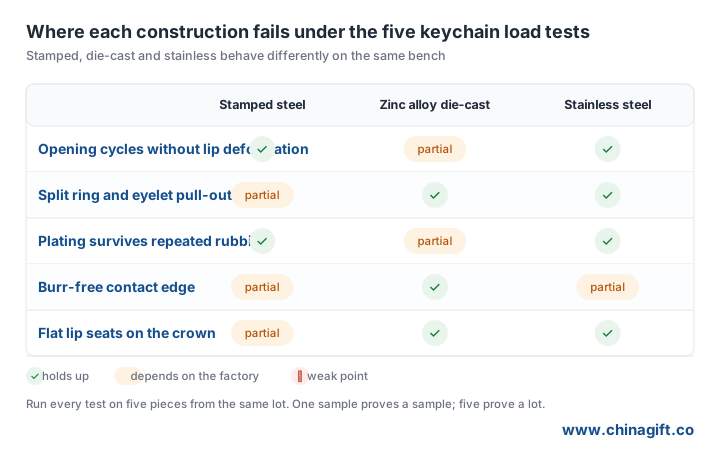
A stamped steel opener generally holds this test well, because the lip is formed from the same sheet as the body. A die-cast zinc alloy opener depends on how the lip was cast and finished — a casting with porosity near the lip will show a chip or a crack rather than a smooth wear patch. If the lip has visibly flattened after fifty bottles, it will be reported as "does not open bottles" by the end of the campaign.
Test two: hang ten kilos from the ring
Put the split ring in a vice or on a hook, attach a ten-kilo weight to the opener body through a loop of cord, and lift. Hold it for ten seconds. Ten kilos is roughly the load of a bag of shopping caught on the ring, which is how these items usually break rather than through any bottle-related force.
Where it fails tells you about the construction. On a stamped body, the eyelet is usually a pierced tab or a welded loop; a pierced tab in thin sheet will tear at the hole, and a welded loop will fail at the weld rather than the metal. On a die-cast body the ring hole is cast in, so it either holds or the whole piece cracks. On stainless the ring hole is the same story, so pay attention to whether the hole has been deburred — a sharp hole cuts the split ring open over time.

Test three: rub the plating with a coin
Take a coin and rub the flat face twenty times, firmly, in one direction. Then press a strip of clear tape over the rubbed area and pull it off. Plating that is properly bonded will show a polish mark and nothing on the tape; plating over a poorly prepared surface will lift flakes or leave a grey smear on the tape.
Repeat on an edge, where plating is thinnest and where a pocket will wear it first. On die-cast zinc, the common failure is blistering around a casting defect rather than uniform wear — a small bubble that opens into a flake. On stainless there is no plating to fail, which is why stainless items survive a keys-in-pocket year that a plated item does not. The trade-off is cost and the range of finishes available; a plated zinc body can be made in a wider set of colours and shapes.
Test four and five: the edge, and whether the lip seats
For the edge, run a fingernail along the entire perimeter, then drag a tissue across the same path. A burr will catch the tissue and will also catch thread in a pocket. Check the inside of the ring hole the same way — it is the most commonly skipped edge on a shaped opener, and it is the edge that touches a split ring every day.
For the lip, open three different bottles: a standard crown cap, a crown cap on a returnable bottle, and a crown cap that has been crimped slightly tighter than usual. A well-formed lip seats on all three with a short lift and no slip. If the opener needs two attempts on the tighter cap, or if it slides off and leaves a scratch on the crown, the lip is either too thick or not flat. Check the gap between the lip and the body with a caliper — a lip that varies along its width will work on some bottles and fail on others, and the customer will not tell you which.
Record the result so it survives the second order
Write the five results into the specification, not into an email. For each test, record what you did and what you accepted: fifty openings with no visible lip flattening, ten kilos held for ten seconds with no deformation at the ring, no plating lift on the tape test, a tissue that does not snag anywhere on the perimeter, and a lip that seats on all three cap types. Then keep the five tested pieces and one untested piece in a bag with the order number.
That bag is your second-order specification. When the next lot arrives, test it the same way: what changes between lots is rarely the drawing — it is the plating bath, die wear, or a different split ring supplier. Browse the bottle opener keychain range to see how much the body shape changes the lip and ring geometry before you fix a specification.
Need promotional gifts for your campaign?
Send your brief and quantity for a quote and a digital proof.
Get a free quote


