Retail POP Displays: Corrugated vs Rigid Board
Choose corrugated when the display is used once and thrown away; choose rigid board when the same unit has to survive several campaigns and hold real weight. That single line decides most retail POP programs, and the rest of this comparison is about the cases where the line blurs — a corrugated unit with a litho-laminated skin, or a rigid unit so heavy that freight eats the difference.
What the Two Boards Actually Are
Corrugated board is a liner-flute-liner sandwich. The flute letter tells you the thickness: B is around 3 mm, C around 4 mm, E around 1.5 mm and F under 1 mm. A thicker flute adds stiffness and stacking strength; a finer flute gives a smoother face for printing. Corrugated displays ship flat and are folded and locked on site, which is why they dominate seasonal and short-run programs.
Rigid board — often called greyboard or chipboard — is a solid paperboard core, usually 1,200 to 2,000 gsm, wrapped in printed paper. It has no flutes to crush, so it holds a square edge and takes a wrap that looks like furniture rather than packaging. It does not fold: the unit arrives part-assembled or in panels that are glued and slotted at the store.
Load: What a Shelf Will Hold
Corrugated strength is not one number. It is measured by edge crush and burst tests, and it depends on flute direction, the number of shelves and how the unit is braced. A C-flute shelf spanning 600 mm will sag under a load that an E-flute shelf of the same span carries without visible deflection, because the deeper flute puts more material further from the neutral axis. If the product is heavy — bottles, tools, jars — ask for the shelf span and the load per shelf in writing, and ask for a loaded sample, not an empty one.
Rigid board handles point loads better because the core is solid, but it has its own failure mode: the wrap splits at the fold when the unit is dropped, and a split edge cannot be repaired. Test the loaded unit by lifting it an inch and dropping it, then inspect the corners.
Reuse: How Many Setups the Display Survives
This is where the cost comparison actually turns. A corrugated unit is designed for one assembly: the locks are folded once, the tabs engage once, and taking it apart and rebuilding it softens the flutes at every fold line. Two or three setups is the realistic life of a well-made unit; a cheap one will not survive the first re-pack.

Rigid board units are rebuilt differently: the panels are screwed, riveted or slotted into a frame, so the same unit can be stripped and re-dressed with new printed panels. If the retailer keeps displays for two or three seasons and swaps the graphics, rigid board wins on total cost even though the first unit is more expensive.
Print: Where the Gap Is Real and Where It Closes
Direct printing on corrugated is usually flexographic, and flexo on a brown kraft face cannot hold fine type or a photographic gradient. The fix is litho lamination: print the graphic on a coated sheet by lithography, then laminate that sheet onto the corrugated. The result looks close to rigid board and costs more than plain flexo but less than a full rigid unit.
Rigid board is wrapped in litho-printed paper by default, so photographic imagery is its native mode. If the display carries a product photo, a brand crest with fine serifs, or a colour match to packaging, rigid board removes a whole class of approval problems. If the graphic is a headline, a price flash and a logo, flexo on corrugated is honest and cheap.
Freight, Assembly and Storage
Corrugated ships flat in a bundle and takes minutes to set up, so freight per unit is low and a store can hold stock in a back room. Rigid board ships as panels or part-built, occupies far more volume per unit, and needs someone at the store who can glue, slot and square it — which many retail chains will not do.
Add the disposal end: corrugated goes into the store's cardboard baler with the rest of the packaging, while a rigid unit with a laminated wrap and metal fittings often has to be separated or sent back. For a program with dozens of stores, that handling difference frequently outweighs the unit price.
A Five-Question Spec Sheet
Before the quote, answer these five: how many setups will the unit see, what weight sits on each shelf and over what span, does the graphic contain a photograph, will the store assemble it or does it arrive built, and how is it disposed of at the end of the campaign.
The matrix below lines the two boards up against the requirements that usually decide the answer.
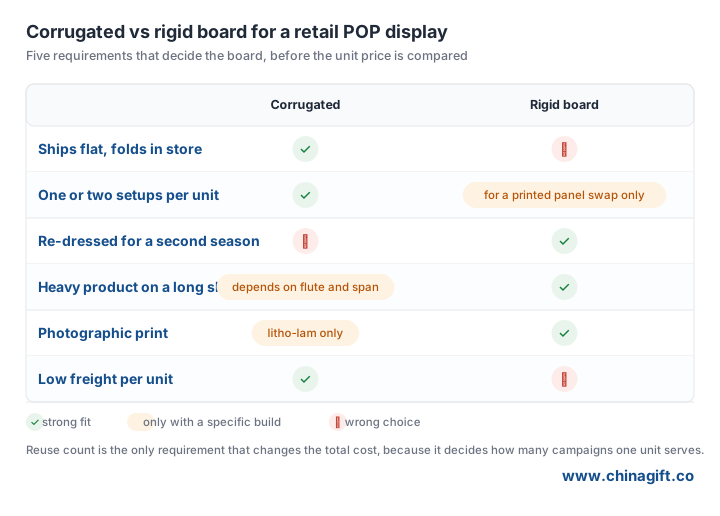
If the campaign is one season and the graphic is simple, order cardboard display stands in corrugated and put the budget into the print. If the display has to be re-dressed for a second season, price the rigid version including freight and assembly before you compare it with corrugated — the unit price alone will point the wrong way.
Need promotional gifts for your campaign?
Send your brief and quantity for a quote and a digital proof.
Get a free quoteRelated products
 Strong POP Cardboard Display Floor Display Stands For Hellokitty Backbag Mobile CaseCG18259
Adjustable Shelf POP Cardboard Display Cardboard Display Stand for Beauty Care ProductsCG18263
 Beautiful Four-shelf POS Cardboard Displays Glossy Lamination for Electronic ProductsCG18282
 Fashionable POS Cardboard Display Stands Hook Floor Display for JewelleryCG18289
 Custom Four - shelf Cardboard Display Stands Cardboard Shelf Display For Plush ToysCG18308