Camping Cookware Anodizing: 5 Specs That Decide Price
Two camping cook sets can look identical in a supplier photo and differ by close to half at the factory, and the difference is rarely the pot. It is the layer on the aluminium: how thick it is, how it was made, and whether anything sits on top of it. Anodizing is the first thing a buyer is quoted on and the last thing they can see.
This is a buying guide, not a chemistry lesson. Five specifications decide the price of a hard-anodized cook set, each one has a number you can put in a request, and each one has a bench check that tells you whether the sample matches the paper.
Type II and Type III are different products
Anodizing converts the aluminium surface into aluminium oxide by running current through it in an acid bath. Type II, the decorative process, builds a layer of roughly 5 to 25 microns and is what gives a coloured cook set its finish. Type III, sold as hard anodizing, runs colder and denser and builds 25 to 50 microns with a much harder surface. Both are anodic layers; only one of them is worth putting a folding handle on and selling to someone who will scrub it with sand.
The practical consequences follow the thickness. Type II resists fingerprints and mild corrosion and dyes well. Type III resists abrasion and holds up to a gas flame licking the outside of a pot, and it costs more because the bath runs longer at tighter control. When a quote says "anodized" and nothing else, you are almost certainly being priced on Type II, and the sample will look the same in the photo.
Ask for two things in writing: the type, and the coating thickness in microns with the tolerance. A supplier who only answers "good quality anodized" has not answered. If the answer is 25 microns, ask who measures it and with what.
Alloy and wall thickness set the floor price
Cook set bodies are usually 3003 or 3004 aluminium, both chosen because they deep-draw without splitting. Thinner walls cost less metal and heat faster, which sounds like a feature until the pan scorches a tomato sauce in the middle and stays cold at the rim. Camping sets commonly run 0.8 to 1.0 mm on the body and slightly more on the base; jumbo sets and anything aimed at family car camping go to 1.2 mm and above.

Hard anodizing a very thin wall at a tight draw radius crazes along the radius, and factories deal with that by thinning the anodize or choosing a softer alloy. So a quote that is unusually cheap on a thin body is often cheap because the layer was reduced to keep the part from cracking. Ask for the wall thickness at the base and at the rim, not one average figure.
The base decides whether it works on the stove
Aluminium is not magnetic, and an induction hob will not see it. Induction-compatible camping cookware carries a stainless steel disc bonded into the base, and that disc is one of the largest single cost differences between two sets that look the same from above. A plain anodized base is fine on gas and on a camping stove; a bonded base adds a part, a press step and a quality risk if the bond fails and the disc lifts after a few heat cycles.
Check it with a fridge magnet on the outside of the base: it should grip firmly and evenly. A weak grip at the centre and none at the edge is a disc that is domed, and domed bases rock on a flat hob and cook unevenly. Then boil water in it twice and let it cool; a base that clicks as it cools is telling you the bond is moving.
Anodized is not non-stick
This is the most expensive misunderstanding in the category. An anodized surface is hard, corrosion-resistant and slightly porous after sealing, and an egg will still stick to it. Non-stick comes from a coating applied on top: PTFE, or a ceramic sol-gel, sprayed and cured inside the pot. A set described as "hard anodized non-stick" is two products, the layer and the coating, and the quote should price them separately.
Ask which coating, on which surfaces, and how many coats. A single-coat interior on a set sold for daily use is a twelve-month product; a two or three-coat system with a primer is what most mid-market sets use. For anything sold into the EU or the US, also ask for the food-contact declaration — the FDA route for the US and LFGB for Germany are the two documents buyers are usually asked for, and they cover the coating rather than the anodize.
What to put in the spec before you compare quotes
Five lines, in this order: alloy and wall thickness at base and rim; anodize type and thickness in microns; whether the interior is bare anodized or coated, and with what; whether the base carries a bonded stainless disc; and the set content down to lid and mesh bag. Add the nesting height of the packed set, because a thicker wall changes whether seven pieces still fit inside the largest pot.
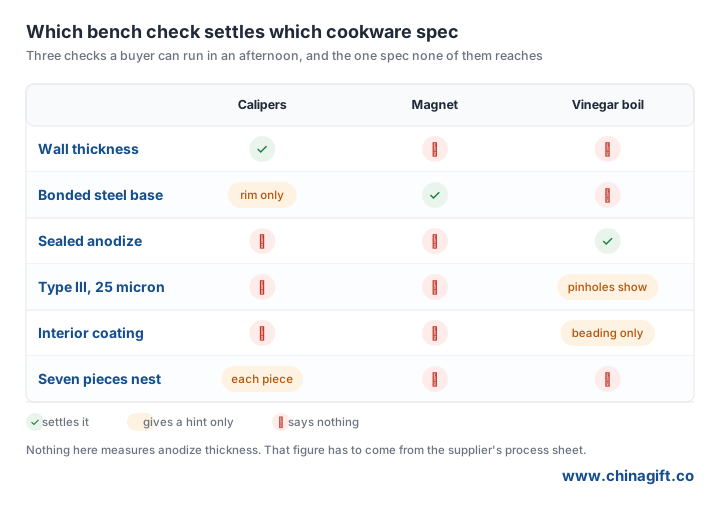
Three bench checks cover most of it in an afternoon. Calipers on the rim and the base of every piece, a magnet on the base, and a thirty-minute boil in water with a spoon of vinegar followed by a salt rub to see whether the anodize blooms chalky white. What none of them gives you is the thickness in microns: that needs an eddy-current gauge or a lab, so it has to come from the supplier's process sheet, written into the order with a tolerance.
One last line: acidic food. Anodizing slows the reaction between aluminium and tomato or citrus, it does not stop it, and a scratched interior is where it starts. If the set is going to a customer who simmers sauce, the coating specification matters more than the anodize spec, and saying so in the listing prevents the review that says the pot tasted of metal.
Need promotional gifts for your campaign?
Send your brief and quantity for a quote and a digital proof.
Get a free quote


