Metal Keychain Materials: Zinc Alloy vs Brass vs Stainless
Three base metals cover nearly every custom keychain quote: zinc alloy, brass and stainless steel. The choice is not a quality ladder. It decides which shapes are possible, how fine the engraving can go, whether the piece needs a plating line at all, and how the item feels in the hand when a recipient picks it up at a trade show. Knowing which property you are buying is what keeps a quote from drifting after the sample.
Zinc Alloy: The Shape Metal
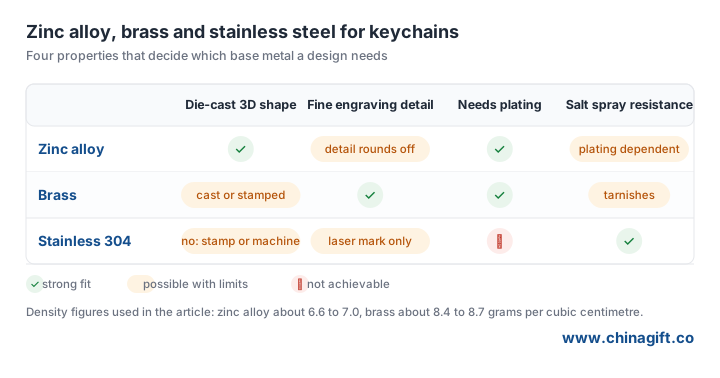
Zinc alloy, usually a zamak grade, is die cast. Molten metal is injected into a steel mould, which means complex three-dimensional shapes, undercuts, deep relief and pierced outlines come out of the tool in one shot. That is why bottle openers, animal shapes and character keychains are almost always zinc: the alternative would be several stamped parts welded together.
The trade-offs are density and section thickness. Zinc sits around 6.6 to 7.0 grams per cubic centimetre, so a zinc piece feels lighter than brass of the same size, and thin sections bend or snap. Mould design has to keep walls thick enough to fill, and screw posts or split rings need enough meat around them. Zinc also has to be plated for a decorative finish, and the plating is what the buyer actually judges: a bright chrome or a soft nickel both sit on top of the same casting.
Brass: The Detail Metal
Brass is denser, roughly 8.4 to 8.7 grams per cubic centimetre, and it machines and stamps cleanly. It holds fine detail far better than zinc: sharp engraving, crisp stamped lettering, thin raised borders and small engraved text that stays legible after plating. If the design depends on a fine line or a small logo, brass is the material that reproduces it.
Brass is also the most forgiving for a premium feel, because the weight is what the hand notices. The cost sits in the material and in the finishing steps: brass tarnishes, so it needs plating, lacquer or a deliberate antique finish. A raw brass piece that is handled daily will darken, which is either the point of the design or a complaint, depending on what the buyer promised.

Stainless Steel: The Finish Metal
Stainless steel cannot be die cast, so a keychain in 304 is stamped, laser cut, machined or cast by investment and then polished. What it buys is corrosion resistance without plating: a brushed or mirror stainless piece keeps its surface after months on a keyring, which matters for outdoor, marine and tool-adjacent promotions. It is also the hardest of the three, so it resists scratching better than a plated zinc surface that can chip through to the base metal.
The constraint is decoration. Laser marking on stainless produces a dark, durable mark but not a coloured one, and pad printing needs a pre-treatment to adhere. If the design calls for a bright colour fill or a gold tone, stainless becomes the more expensive route, because the colour has to be applied and protected rather than plated.
How to Choose Without Overpaying
The decision usually collapses to three questions. Does the shape need to be three-dimensional or pierced? Then it is zinc or cast brass, and zinc is the cheaper route for volume. Does the design depend on fine lettering or a small engraved logo? Then brass earns its cost, because zinc will round the detail off. Will the piece live on a keyring outdoors and be judged on wear rather than on colour? Then stainless, finished brushed or mirror, is the material that keeps looking like itself.
Two secondary questions settle the rest: whether the buyer wants weight in the hand as a perceived-value signal, and whether the finish has to match an existing metal product in the same gift set.
Checks on the Sample Before the Bulk Run
Material claims are easy to make and hard to see, so test the sample rather than the spec sheet. Weigh the piece: a zinc body of the same dimensions as a brass one will be noticeably lighter, and a piece that matches the brass weight is not zinc. Look at the thinnest section under a light for sink marks or a short fill, which is a mould problem that appears in every piece. Check plating thickness at an edge with a caliper if the supplier has a coating gauge, or ask for the salt spray hours in writing. Bend a thin arm once: zinc will show stress whitening before it breaks, brass will bend, stainless will spring back.
Finally, drop one sample on a hard floor. Plating adhesion shows up at the edges first, and a chip at the edge of a zinc casting is the failure that reaches the end user.
Send the shape, the quantity and the finish you have in mind, and we will quote zinc, brass and stainless side by side with the tooling and plating cost of each, so the material decision is made on the full number rather than on the unit price alone. Start from the metal keychain range to see which constructions are already tooled.
Need promotional gifts for your campaign?
Send your brief and quantity for a quote and a digital proof.
Get a free quote


