Gift Set MOQ: The 4 Lines That Set Your Minimum
A gift set MOQ is not one number a salesperson picks. It is the highest of four independent floors — components, kitting labour, tooling and packaging — and the quote you receive is simply whichever floor is tallest. That is why two suppliers can quote 300 and 1,000 sets for a similar box: they are limited by different lines, not by different generosity.
Line one: the component minimum
Every item inside the set has its own minimum from its own factory. A scented candle is poured in a wax batch; a ceramic vessel is fired in a kiln load; a tin, a pouch or a printed sleeve comes with a converter's minimum. If the set holds four items from four suppliers, the set minimum is set by the slowest of the four, not by the assembly line.
This is where most first quotes go wrong. A buyer asks for a set of candle plus matches plus a card, receives a price for 500, and assumes the factory is being difficult. In practice the candle pour and the matchbox print each carry a floor near that figure, and no amount of negotiation on the assembly step will move either.
The practical move is to consolidate. Two items from the same supplier, or two items in the same material family, usually share a batch. If your set can use one candle size in two scents rather than two sizes in two scents, you have removed a whole batch without changing what the customer sees.
Line two: kitting labour
Kitting is the step where components become a set: counting, bagging, folding the insert, placing the card, closing the box, weighing and labelling. It is manual, so its floor is a working session rather than a material batch. A kitting line that sets up for 200 sets will usually run 200 as cheaply as it runs 120, which is why the labour floor sits below the component floor on simple sets and above it on complex ones.

Ask for the kitting time per set in minutes and the number of stations. A set that takes four minutes at one station and a set that takes one minute at four stations give the same total, but the second absorbs a small order far better. If your quantity is small, you want the second layout.
Line three: tooling
Tooling is the only line that is genuinely one-off, and it is the one buyers most often forget to separate from the unit price. A printed box needs plates or a digital setup, a foiled lid needs a die, a moulded insert needs a cut die, and a custom vessel may need a mould that costs more than the entire order.
Separate the tooling cost from the unit cost in the quote and ask which items are reusable on a reorder. A cut die and a print plate survive; a mould survives but only for that exact shape. Once you know what is reusable, the second order becomes the real test of the price — if the unit price does not drop once tooling is amortised, the tooling was not the constraint and something else is.
Line four: packaging
Gift sets are packaging-heavy by definition, and packaging has its own minimums that often exceed the product's. A rigid box converter may run a minimum sheet count per size; a printed sleeve has a plate; a foam or paper insert has a die. A box that fits the set exactly will always cost more per unit at low volume than a stock size with a printed label.
Two decisions cut this line quickly: use one box size across the whole range so the converter's minimum covers several SKUs, and choose an insert that can be cut from a standard die rather than a bespoke one. Neither change is visible to the recipient, and together they can move the packaging floor below the component floor.
Finding which line is actually binding
You cannot negotiate a minimum down without knowing which floor you are standing on. Ask the supplier to quote the same set at three quantities — say the quoted minimum, double it, and half of it — and watch which cost element fails to scale. If the unit price barely moves between the first two quantities, you are on a batch line; if it falls steadily, you are on a labour line.
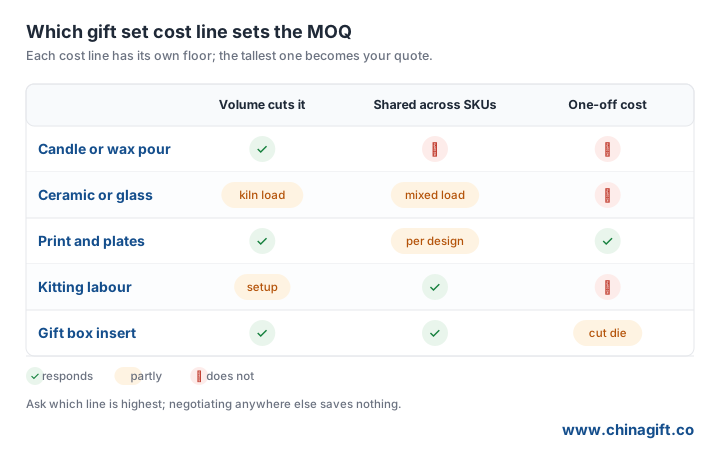
Then attack the tallest line specifically. Share a mould across two products, standardise the box, drop one SKU, or split the order so the components run at their own minimums and the kitting runs at yours. Buyers who ask for "a lower MOQ" get a shrug; buyers who ask "which line sets this number" get a plan.
The same logic applies across the rest of the mixed gift range: sets built from stock components and a standard box reorder predictably, while sets built from a bespoke vessel and a fitted rigid box carry a floor you will meet on every order.
Need promotional gifts for your campaign?
Send your brief and quantity for a quote and a digital proof.
Get a free quote


