Metal Keychain Sourcing Calendar: 6 Lead Times to Plan Around
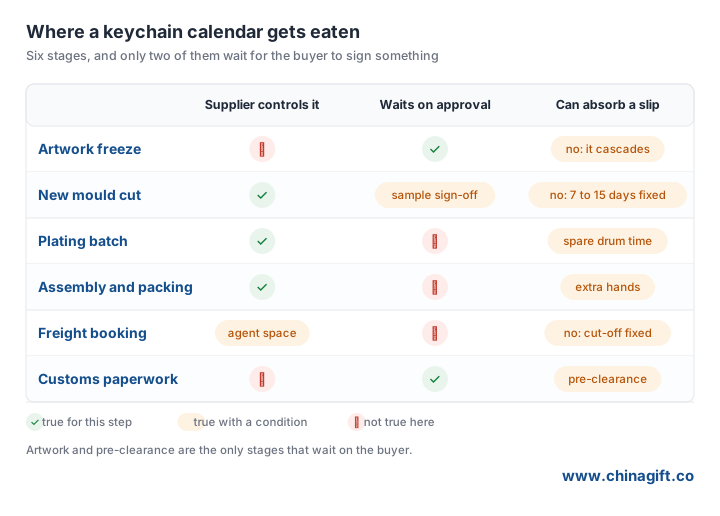
A keychain programme does not fail on price. It fails because the in-hands date was set first and the six stages behind it were never laid out. Working backwards from the date the boxes have to be in a warehouse is the only planning method that survives, and it produces six locks, each with a number of working days attached and a different person who has to sign.
Lock one: the mould decision, at about eight weeks out
Before anything is quoted properly, someone has to answer one question: does this shape exist in a mould already, or does a cavity have to be cut? Stock shapes are the reason a keychain can be quoted in a day. A new cavity takes roughly seven to fifteen working days for a simple single-sided shape, longer for two-sided relief or a moving part such as a bottle opener hinge, and that time is spent whether or not the design changes afterwards.
Ask for the mould cost as its own line and ask whether the tool belongs to you or stays with the factory. Neither answer is wrong, but they price differently on a repeat order, and a buyer who discovers the answer after the first run has already lost the negotiation.
Lock two: artwork freeze, because every later stage reads from it
Artwork is not approved when it looks right on a screen. It is approved when the file is vector, the line weights are stated in millimetres at final size, and someone has decided whether the logo is engraved into the metal or printed onto it. Engraving holds up on a zinc alloy die casting and reads as a recess; printing allows colour but sits on top of a plated surface, where adhesion depends on the plating being clean.
Two practical checks save a week here. First, ask for the artwork laid over the actual mould outline, not over a generic shape, because a recessed border eats two millimetres of printable area that a flat drawing does not show. Second, decide the plating colour before approving ink colours, since the same ink over shiny nickel and over antique brass reads as two different logos.
Lock three: the plating batch, which is where colour consistency is won
Plating runs in batches, and a batch is a drum, not a piece. If the order is large enough to need two drums, the second drum is where a shade difference appears, and it appears on a gift that will be handed out side by side at the same event. Ask how many pieces a drum holds for this size and finish, and whether the whole order can be run in one batch; if not, ask for a colour chip from each batch before assembly.
Plating also adds three to five working days after casting, and it is the stage most likely to be subcontracted, which means it is the stage where a delay is least visible to you. Put a date on it in the schedule rather than assuming it follows casting immediately.

Lock four: assembly and packing, the quiet two weeks
Individually bagged, backed with a printed card, barcoded and boxed is four operations, and each one can add a day per thousand pieces if it was never quoted. This is also where the freight bill is decided: a keychain is light, so the carton cube rather than the weight usually sets the chargeable figure, and a backing card that adds five millimetres to each unit can change the number of cartons on a pallet.
Ask for pieces per carton and carton dimensions in centimetres at the quotation stage, then calculate volumetric weight yourself. A supplier who cannot give those two numbers before production is a supplier who has not packed this item before.
Lock five: the freight cut-off, booked before production ends
Air freight runs about five to seven days door to door on a normal lane, express three to five, and sea twenty-five to thirty-five, and the booking has to exist before the goods are ready or the shipment sits. The cut-off that matters is not the sailing date but the date the forwarder needs the documents and the packed dimensions, which is typically several days earlier.
Build the schedule so that production ends at least a week before the forwarder's document cut-off, not the other way round. That week is the buffer that absorbs a plating re-run, and it is the only slack in the whole calendar that does not cost money to hold.
Lock six: the holiday window, and the dates that do not move
Factory closures around the lunar new year remove two to three weeks from the calendar, and the effect is felt four to six weeks before the closure as production queues ahead of it. Orders that would normally take twenty days can take thirty-five in the month before a closure, and freight space tightens at the same time. If the in-hands date falls in the first quarter, the production booking should be placed before the closure, not after it.
The same logic applies to retail deadlines: a programme for a December event needs the goods landed by early November, which puts production in September, which puts artwork approval in August. Written backwards, the calendar stops being a negotiation and becomes a list of dates with names next to them, and the metal keychain range can be quoted against a real schedule instead of a wish.
Need promotional gifts for your campaign?
Send your brief and quantity for a quote and a digital proof.
Get a free quote


