Keychain Engraving Depth: Laser vs Etch on Zinc Alloy
Ask two suppliers for "engraved keychains in zinc alloy" and you will get two different objects. One hands you a charm with a mark a few thousandths of a millimetre deep, dark from oxidation, that reads as a print. The other hands you a cavity you can feel with a fingernail and fill with enamel. Both are called engraving, both are legitimate, and the choice between them is decided by whether you intend to fill the mark with colour.
Here is what each process actually removes, how deep it goes, and the magnifier check that tells you which one you received before you approve 5,000 pieces.
Two processes, two different holes
Laser marking on zinc alloy is a surface effect. A fibre laser melts and partially oxidises the top layer, producing a mark typically 5 to 20 micrometres deep — 0.005 to 0.02 mm. The material is not removed so much as altered, and the mark is dark because the surface is now oxidised and roughened rather than because it sits in a channel.
Deep laser engraving is the same tool run slower, with more passes and higher energy density. It removes metal, reaching 0.05 to 0.20 mm depending on how many passes the job is quoted for. The cavity has a V-shaped profile: wider at the top than the bottom, with walls that slope.
Chemical etching is a bath process. The part is coated with a photoresist, the artwork is exposed and developed, and the exposed metal is dissolved. Depth lands around 0.05 to 0.15 mm and is uniform across the whole design because the whole design is in the bath for the same time. The walls are closer to vertical than a laser V, and the floor is flat.
The fill question decides it before anything else
If the mark is going to hold paint, enamel or a two-tone effect, the cavity has to be deep enough to keep the fill below the surface. Practical floor is 0.05 mm, and the fill also needs a wall the paint can grip. Below that depth the fill sits proud, wipes off in handling, and shows as a smeared edge within a week of the trade show.
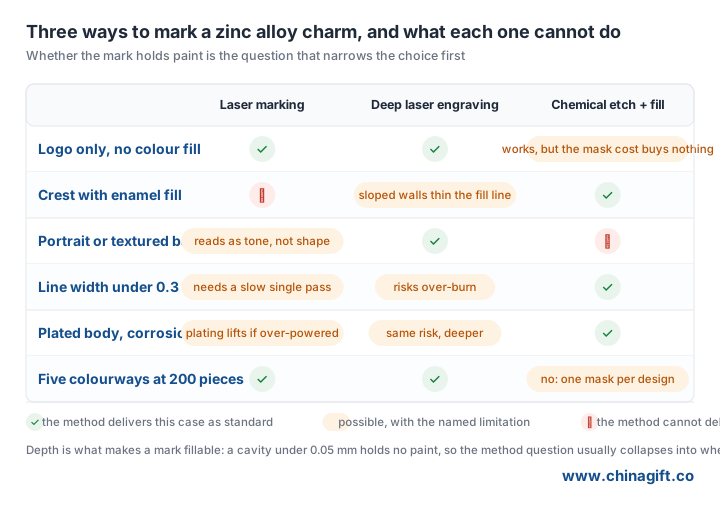
That single number splits the field. Laser marking at 0.01 mm cannot be filled — it can only be left as a dark mark, fine for a logo on a brushed face and useless for a red-and-white club crest. Deep laser engraving at 0.08 mm can be filled, but the sloped walls make the fill line thinner at the bottom than the top, which matters on a fine outline. Chemical etch at 0.10 mm with near-vertical walls takes fill most predictably, which is why trophy and badge work still uses it.
Where each one fails on zinc alloy specifically
Zinc alloy is plated — nickel, then chrome, gold or antique brass, usually 3 to 10 micrometres total. A laser that cuts through the plating exposes the base metal, and exposed zinc alloy in a pocket with keys will corrode and bloom white within weeks. The failure shows as a dark halo or a lifting edge around the mark, not in the mark itself.
Etching has the opposite constraint: every design needs its own photomask and bath setup, so it carries a fixed cost per design that laser does not. It also cannot vary depth within one design, so a graduated or photographic effect is out. Laser can vary depth point by point, which is how a portrait or a textured background gets made, but the same flexibility makes it easy to over-burn a thin wall.

Judge the depth with a loupe, not a photograph
You need a 10× loupe, a good side light and one straight edge. Look at the wall of the mark where it meets the surface: a laser mark has a raised rim of displaced and re-solidified metal, a rounded profile inside, and no distinct floor. An etched cavity has a sharp edge, a visible wall and a flat floor that catches light as a uniform patch.
To measure rather than describe, lay a single-edge razor blade across the mark and sight along it under the loupe; the gap between blade and cavity floor, compared against a feeler gauge or a caliper jaw, gives you the depth to within about 0.02 mm. Crude, but it separates a 0.01 mm mark from a 0.08 mm cavity every time, which is the only distinction that matters commercially.
Run a fingernail across the edge of the mark: a lip that catches means the laser lifted the plating, and that piece will corrode. Then press a strip of clear tape over a filled mark, rub it down and pull: any fill that comes away on the tape is under-cured or sitting above the surface.
Cost and lead time follow the tooling, not the unit
Laser is digital: no mask, no bath, no per-design tooling, so an artwork change costs a file and a setup, and per-unit time rises with depth — a 0.15 mm engraving can take several times longer per piece than a 0.02 mm mark. At volume the machine time becomes the cost line, not the design.
Etch is the reverse. The mask and bath setup are fixed costs per design, absorbed across the run, and the per-unit cost is nearly flat once the line runs. That makes etch attractive on one design at volume and unattractive on five colourways of 200 pieces each. Neither method is cheaper in the abstract; count the designs, not the pieces.
Write the depth, the fill and the plating rule onto the order
An order that says "engraved logo, gold keychain" will produce either method depending on which workshop picks it up. Specify the method, the minimum depth in millimetres, whether the mark is filled, and the plating rule — no penetration of the plating layer at any point of the mark. Add the inspection: 10× loupe, razor-blade depth check on three pieces per lot, tape pull on every filled colourway.
Keep one approved piece per colourway with the depth written on its tag, and compare each delivery against it rather than against the photo in the catalogue. Browse the metal keychain category to see which bodies the current range casts, then send the artwork with the finest line width called out — that line is what decides whether the design survives at 0.08 mm or needs to be simplified first.
Need promotional gifts for your campaign?
Send your brief and quantity for a quote and a digital proof.
Get a free quote


